Arranged or contractual marriage
SCOTTISH ROMANCE: My Sinful Surrender to a Highlander Werewolf (Scottish Werewolf Pregnancy Romance) (Historical Medieval Shape Shifter Paranormal Science Fiction Short Stories)Arranged or contractual marriage is one of the novel’s central ways of turning intimacy into an institution of exchange. A spouse may be selected to secure a dowry, preserve an estate, obtain citizenship, satisfy a family succession rule, escape grief or deportation, or provide a child. The arrangement can begin as coercion, commercial calculation, or mutual necessity, yet the stories repeatedly test whether affection, care, and consent can survive inside a bargain whose terms were set by poverty, inheritance, family authority, immigration law, or unequal power.
Definition and Social Forms
Arranged or contractual marriage appears most starkly in Freya’s childhood marriage to Angus. At fourteen, Freya was married off for a minimal dowry, although Angus had also chosen her because he desired her red hair and pale complexion. Six years later, he continued to resent the small payment made by her parents and converted that resentment into public humiliation. He spread accusations about Freya’s fidelity while openly bringing other young women home from the tavern, leaving Freya to serve breakfast to him and his latest partner at the same kitchen table. The marriage therefore joins two kinds of arrangement: a family’s economic transaction and a husband’s claimed ownership of the wife’s labor and body. Its formal existence does not protect Freya from abuse; instead, it gives the abuse a household structure that the village chooses to tolerate.
The werewolf social order supplies another version of arranged union. Tate’s father informs him that a marriage with Accalia has already been arranged between their families and that Accalia has accepted the offer. The match is tied to pure-blood status, rank, and succession rather than to Tate’s wishes. Tate understands the ancestry behind his family’s insistence on purity, but rejects the idea that a werewolf who is not purebred is lesser, and he considers Accalia’s treatment of humans and lower-status pack members intolerable. His refusal turns a family marriage agreement into a political rebellion: he risks excommunication, the loss of his princely title, and separation from the established pack in order to choose Sheldandra.
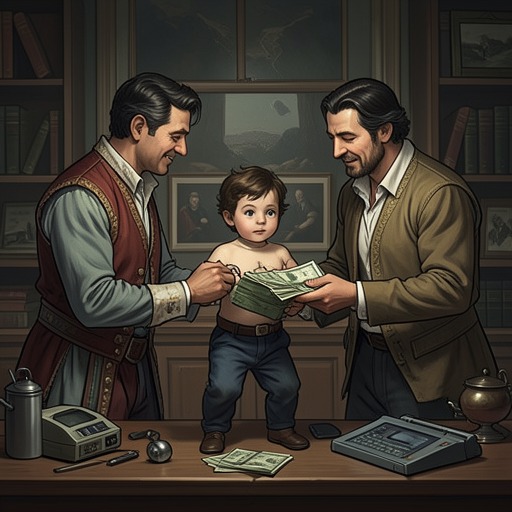
The same pattern becomes more visibly contractual in William’s inheritance crisis. His family’s estate, home property, and business can pass fully under his control only if he marries and produces an heir apparent; the heir may be male or female, but the requirement is absolute. Because William devoted himself to his career and neglected relationships, he is the first heir in generations to face the stipulation directly. He and his lawyer therefore recast marriage as a business deal. A mail-order bride would receive transportation, citizenship, and material care; in return, she would remain married to William for at least ten years and bear a child, while the contract would prevent her from claiming part of the estate. The ironclad agreement makes the asymmetry explicit: the bride’s future, reproductive capacity, and legal position are treated as terms to be secured for the protection of inherited property.
Marriage as Escape and Economic Strategy
For Abigail, a proposed marriage to a wealthy American is presented as a calculated escape from social isolation and traumatic loss. She tells Sally that she has effectively sold herself to a rich American so that he can inherit his family fortune, after which she intends to divorce him, use the money he gives her, and return to London to establish her own business. Sally’s summary makes the transaction sound simple, but Abigail’s tears reveal the emotional cost concealed by its financial logic. Two years earlier, Abigail had lost her family when their yacht capsized; she alone survived, while the bodies of her older brother and mother were recovered and her father and younger sister were taken by the sea. The proposed marriage is thus not merely a mercenary bargain. It is an attempt to buy distance from grief, financial independence, and a new identity through a husband whose own inheritance needs make him willing to participate.
Avril’s e-mail-order marriage begins under the pressure of immigration law and professional survival. She has built a celebrated restaurant career, continually developing new dishes while Timothy, her right-hand man, helps her pursue her talent. Yet her work visa has expired, and she is due to be sent back to Nigeria, a country she does not want to return to. She finds what appears to be a solution online by becoming an e-mail-order bride, only to discover that the man she contacts is a regular customer at her restaurant. Her marriage is therefore shaped by the collision of culinary labor, visa precarity, and the marriage market: professional success cannot protect her from the legal condition that makes a husband seem necessary.
Emma’s decision follows a different route out of displacement. After a house fire destroys her home and takes her family members, she remains with painful reminders, mounting bills, and the absence of Jasper, the family breadwinner. She is uncertain about becoming a mail-order bride, but decides to leave England for Lucas in Texas because he is a good man who needs help with his niece. The decision is framed as both an emotional departure and a practical relocation. Emma does not claim that the arrangement erases her loss; she says she still does not understand why the tragedy occurred, only that she believes its meaning may eventually become clear. The boat carrying her toward the American West marks marriage as a passage from bereavement into an uncertain new household.
Inheritance, Reproduction, and Negotiated Terms
William’s arrangement reveals how inheritance law transforms reproduction into an estate requirement. The family rule does not simply demand that he marry; it demands that he produce a successor who will keep the property and business within the family. William initially experiences the stipulation as a sudden seizure of his future, since his career-centered life had never included marriage or children as immediate priorities. The contract restores his control only in a limited and troubling form: he can plan the marriage, choose the company, and define the protections, but the plan remains organized around a wife’s service and a child’s legal function as heir.
A related arrangement appears in Dennis’s proposal to Kember. He offers her one hundred thousand dollars for surrogacy, payment of all medical expenses, and a personal-assistant position paying fifty thousand dollars a year with medical benefits. He also offers an open-adoption arrangement under which she could know the child while he raises it according to the life he believes the child deserves. Kember questions the proposal by focusing on the child’s need for a mother and the stability of a two-parent family. Dennis answers with possible substitutes—nannies, a future partner, or Kember’s continued involvement under a parenting plan—but the exchange exposes the limits of contractual language. Money can specify services and access; it cannot settle the emotional meaning of motherhood or guarantee that the participants will experience the arrangement as a clean separation.
Abigail’s proposed inheritance marriage and Kember’s surrogacy negotiation place reproductive capacity beside financial compensation, but they also differ in the degree to which terms are openly discussed. William’s bride is bound by a formal contract designed to prevent an estate claim. Dennis makes his offer directly and leaves room for continued contact. In both cases, however, the person providing marriage or reproductive labor bears risks that the wealthy party attempts to manage through promises, payment, and legal safeguards. The novel repeatedly presents negotiation as evidence of agency while showing that the available choices have been narrowed in advance by money, law, or family expectation.
From Contract to Chosen Partnership
The novel does not treat every nontraditional arrangement as permanently loveless. Jenna and Kyle explicitly reopen their marriage when Kyle’s work keeps him away. Kyle gives Jenna permission to have a boyfriend, presenting an open marriage as preferable to divorce. Jenna enters a bar unsure whether she can flirt with a stranger, still wearing the physical trace of marriage on her fingers. Later, when Kyle must leave again, he tells Rack to take care of Jenna, assures her that he loves her, and accepts Rack as someone who may become part of their life so long as Rack respects their relationship and keeps Jenna safe and healthy. What begins as a negotiated response to absence develops toward a three-person household, showing a contractual arrangement being revised through continuing consent rather than enforced by a single original bargain.
Tate’s refusal likewise turns an arranged match into a chosen relationship. He leaves his father’s authority, takes Sheldandra away from the apartment, and understands that mating with her may provoke war within his family. He expects to lose his title and perhaps be excommunicated, but hopes that members of the pack who are not purebred will follow him and that he and Sheldandra can establish a pack of their own. The decisive change is not simply that Tate chooses love over duty; it is that he imagines a new social order in which the rejected can belong. Their relationship challenges the pure-blood hierarchy at the same time that it challenges the family’s right to arrange his future.
Other relationships show the possibility of warmth after an arrangement or crisis. Penelope, after leaving the house she came from, finds Dave’s smaller home comfortable, lived-in, and safe enough for her to sleep without fear of being in trouble. The next morning, Dave brings bread from the local baker and offers cheese and butter from his cold room. The domestic scene is modest, but its significance lies in contrast: care is expressed through shelter, food, and ordinary hospitality rather than possession. In a similar domestic rhythm, Tate and his partner build a routine of shared dinners, wine, conversation, and his continued counseling training. Their relationship is eventually marked by pregnancy, demonstrating how a bond that begins amid social conflict can become an ordinary shared life.
Critical Significance
Arranged or contractual marriage gives the novel a language for examining the marketization of intimacy. Citizenship, inheritance, wages, dowries, estate protection, family bloodlines, and children repeatedly enter the same negotiations as love and companionship. The recurring question is not simply whether a marriage is arranged, but who writes the terms, who can refuse them, who bears the cost of withdrawal, and whether later affection can alter the original imbalance.
The condition also creates a persistent contrast between legal form and lived experience. Freya’s marriage is recognized but offers no safety; William’s contract is carefully designed but reduces a wife and future child to protections for property; Avril’s marriage promises a route around deportation; Emma’s marriage offers departure from a ruined home; and Jenna’s negotiated openness attempts to preserve love against physical absence. Against these coercive or instrumental forms, the novel places acts of chosen care: Tate accepting the consequences of defiance, Dave providing a safe household, Kyle acknowledging Jenna’s needs, and couples learning routines that are not written into a contract.
Taken together, these stories suggest that marriage becomes ethically meaningful only when the people inside it can participate in its terms and revise them without surrendering dignity, safety, or personhood. The book neither limits arranged marriage to a single culture nor treats every contract as identical. Instead, it traces a spectrum from child marriage and familial coercion through inheritance bargains, immigration strategies, and reproductive negotiations to relationships that retain their original practical structures while acquiring genuine mutual care. Its deepest tension lies in the distance between having a choice on paper and possessing enough security to make that choice freely.